India at IPU Assembly in Tanzania: Parliamentary Diplomacy Takes Centre Stage on Peace, Health and Global Security
An Indian parliamentary delegation led by Rajya Sabha Deputy Chairman Harivansh participated in key discussions at the 153rd IPU Assembly in Arusha, raising issues ranging from Kashmir and terrorism to peace, AI, health and disability rights.

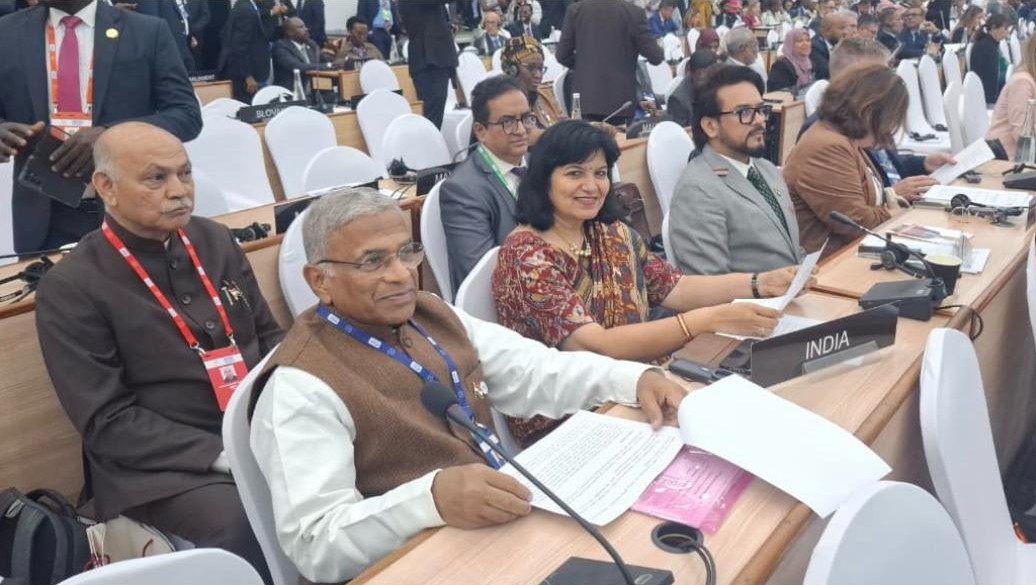
India's parliamentary diplomacy took centre stage in Arusha, Tanzania, as an Indian parliamentary delegation participated in the second day of the 153rd Assembly of the Inter-Parliamentary Union (IPU).
The delegation was led by Rajya Sabha Deputy Chairman Harivansh, with Indian MPs taking part in discussions on some of the most important issues facing the international community—including peace and security, human rights, healthcare, artificial intelligence, terrorism and critical minerals.
The IPU Assembly brings together parliamentarians from countries across the world. Unlike a conventional diplomatic meeting between governments, it provides lawmakers with a platform to discuss global issues, exchange parliamentary practices and build political dialogue.
For India, the Arusha meeting is therefore important not only for participation in international parliamentary discussions but also for presenting the country's position on issues of national and global importance.
Harivansh responds to Pakistan's Kashmir remarks
One of the most politically significant moments for the Indian delegation came when Harivansh exercised India's right of reply following remarks made by Pakistan concerning Kashmir.
India reiterated its longstanding position that Jammu and Kashmir is an integral and inalienable part of India.
Harivansh also rejected what India considers to be Pakistan's attempts to comment on India's internal affairs.
The exchange reflects how the Kashmir issue continues to appear in international forums, including parliamentary and multilateral platforms.
For New Delhi, such forums are important because they allow Indian representatives to respond directly when Pakistan raises the Kashmir issue before international audiences.
At the same time, parliamentary diplomacy operates differently from formal government-to-government negotiations. Its larger purpose is to keep communication channels open between lawmakers, even when governments have serious political disagreements.
Health becomes an important part of India's participation
Dr Sanjay Jaiswal, a Lok Sabha MP and member of the IPU's health-related committee, participated in sessions of the committee.
He also took part in a regional study visit organised as part of the programme.
Health has increasingly become an international parliamentary issue because healthcare is closely connected with economic development, poverty reduction and social equality.
Issues such as access to medicines, public-health systems, pandemic preparedness and healthcare financing can have consequences that extend far beyond national borders.
India has increasingly presented itself as a country capable of contributing to global health discussions, particularly because of its large pharmaceutical industry, vaccine manufacturing capacity and experience in delivering healthcare programmes at scale.
Disability rights and inclusive development Anurag Singh Thakur, a Lok Sabha MP, participated in the Standing Committee on Democracy and Human Rights.
He also took part in discussions on a draft resolution titled:
"Inclusive social development for all: Parliamentary strategies to promote the rights and empowerment of persons with disabilities."
The subject highlights an important shift in the global development debate.
Development is increasingly being measured not simply by economic growth but also by whether people with disabilities, women, minorities and other vulnerable groups are able to participate fully in society.
Parliaments have a particularly important role in this area because they create laws, approve budgets and hold governments accountable for implementing social policies.
India discusses diplomacy and peaceful conflict resolution
Kamaljeet Sehrawat, a Lok Sabha MP, participated in the IPU's Standing Committee on Peace and International Security.
The committee discussed "Shaping a peaceful future: Parliamentary diplomacy, mediation and dialogue for sustainable peace."
The subject has particular relevance at a time when conflicts in different parts of the world are creating humanitarian, economic and security challenges.
Parliamentary diplomacy can provide an additional channel for communication when formal diplomatic relations become difficult.
Lawmakers from countries with opposing positions can still meet, discuss common concerns and explore areas where dialogue remains possible.
For India, this approach fits into its broader diplomatic emphasis on dialogue, peaceful resolution of disputes and respect for national sovereignty.
The AI challenge is moving into the security debate
Another important discussion focused on the growing role of artificial intelligence in military affairs.
Dr Sasmit Patra, a Rajya Sabha MP, participated in a panel discussion on:
"The role of parliaments in maintaining peace in the age of military artificial intelligence."
This is becoming an increasingly important question for governments around the world.
Artificial intelligence is already being used in areas such as surveillance, intelligence analysis, autonomous systems and military decision-support.
The central concern is that advances in military AI could make conflicts faster and potentially more difficult for humans to control.
That creates a new responsibility for parliaments.
Lawmakers will increasingly have to debate questions such as: Who is responsible when an AI-supported military system makes a mistake? How much human control should remain over weapons systems? What international rules should govern military AI? How can AI technology be used without creating a new arms race?
These questions are likely to become increasingly important for India as the country expands its own defence technology and artificial intelligence capabilities.
Tackling terrorism through parliamentary cooperation N.K. Premachandran, a Lok Sabha MP, participated in an IPU workshop focused on strengthening parliamentary responses to terrorism. The workshop examined a proposed IPU framework for parliamentary action against terrorism. Terrorism is not simply a military or intelligence issue. It also involves legislation, financial networks, international cooperation, border security and information sharing.
Parliaments therefore have a role in creating the legal frameworks required to prevent terrorist financing, strengthen investigation mechanisms and improve cooperation between countries.
For India, which has consistently called for stronger international cooperation against terrorism, such discussions provide another opportunity to highlight its concerns.
Critical minerals emerge as a strategic issue
Premachandran also participated in a workshop on: "Critical minerals for shared prosperity: Strengthening parliamentary oversight."
Critical minerals have become increasingly important because they are needed for modern technologies.
They are used in products ranging from electric vehicles and batteries to renewable-energy equipment, electronics and defence systems.
The global competition for these resources is growing.
For India, securing reliable supplies of critical minerals is becoming an important part of both its economic and national-security strategy.
Parliamentary oversight can help ensure that policies relating to mining, imports, strategic reserves, environmental protection and international partnerships remain transparent and accountable.
Indian delegation meets the diaspora in Tanzania The day's programme also included an engagement outside the formal IPU meetings.
The Indian High Commission in Tanzania hosted a cultural programme in honour of the Indian parliamentary delegation.
Following the programme, members of the delegation interacted with members of the Indian diaspora in Tanzania.
Such interactions are an important part of India's overseas engagement.
The Indian community in Africa has historically played an important role in trade, business, professional services and cultural exchange.
For Indian parliamentarians, meeting diaspora communities also provides an opportunity to understand the concerns of Indians living abroad and strengthen people-to-people ties.
Why the IPU matters to India The Inter-Parliamentary Union, founded in 1889, is the global organisation of national parliaments and provides a platform for parliamentarians to discuss international issues and strengthen democratic institutions. Its meetings do not replace formal diplomacy. Instead, they complement it.
Governments negotiate through diplomats and ministries, while parliamentarians can create another layer of international engagement.
This can be especially useful on issues where countries disagree politically but still share common interests. For India, participation in the IPU also provides an opportunity to project its views on democracy, development, terrorism, international security and emerging technologies.
A broad agenda reflects a changing world What stands out from India's participation in Arusha is the sheer range of issues being discussed.
Kashmir and terrorism represent longstanding security concerns. Health and disability rights reflect social-development priorities. Military AI represents a new technological challenge. Critical minerals connect economic growth with national security. And parliamentary diplomacy itself represents an effort to keep dialogue alive in a world increasingly affected by geopolitical tensions.
The Indian delegation's participation therefore goes beyond a series of speeches and committee meetings. It reflects a larger reality: international politics is no longer limited to traditional questions of war, peace and diplomacy. Technology, healthcare, resources, human rights and development are now deeply connected to national security and global stability.
The IPU Assembly provides India with a platform to engage with these issues while also presenting its own perspective before parliamentarians from around the world.
As the 153rd Assembly continues in Arusha, the Indian delegation's participation underlines New Delhi's growing emphasis on parliamentary diplomacy as an additional tool of international engagement.
- Inter-Parliamentary Union (IPU) — Official information on the 153rd IPU Assembly in Arusha, Tanzania.
- Parliament of India / Rajya Sabha — Information on India's parliamentary delegation and participation in IPU proceedings.
- Lok Sabha — Information on Indian MPs participating in IPU committees and workshops.
- Ministry of External Affairs, Government of India — India's positions on international security, terrorism, parliamentary diplomacy and India's engagement with Tanzania.
- High Commission of India, Tanzania — Information on India's diplomatic and diaspora engagement in Tanzania.
Report a mistake
Related stories
SC Notice to Centre on Privacy Law as News Publishers Warn It Could Shut Newsrooms
Om Birla Opens BRICS Parliamentary Forum, Calls for Dialogue and Cooperation
12th BRICS Parliamentary Forum Begins in Delhi on October 26; PM Modi to Attend
Reader comments (0)
No comments yet. Be the first.