Rajnath Singh at SCO: India Pushes for Joint Action Against Terrorism and Stronger Trade Links
At the SCO meeting in Dushanbe, Rajnath Singh called for united action against terrorism and stronger cooperation on trade, transport, technology and economic development across member countries.

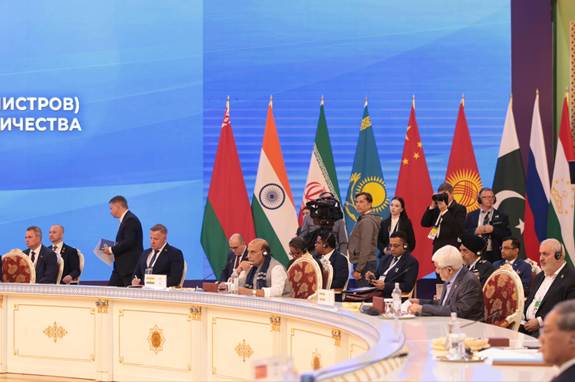
India has called on countries belonging to the Shanghai Cooperation Organisation (SCO) to work together against terrorism and strengthen cooperation across the region.
Defence Minister Rajnath Singh made the appeal while addressing the 25th meeting of the SCO Council of Heads of Government in Dushanbe, Tajikistan, on October 20, 2026.
His message was clear: fighting terrorism requires more than stopping individual attacks. Countries must also target the wider networks that finance terrorists, support their activities and provide them with safe places to operate.
Singh described terrorism as one of the biggest threats to peace and development. He said it takes innocent lives, harms trade and investment, encourages radicalisation and deprives young people of opportunities.
He also stressed that terrorism cannot be justified under any circumstances. According to him, countries should not apply double standards when dealing with terrorist groups or allow those who fund and shelter them to escape responsibility.
In simple terms, India wants regional countries to work together against the entire system that allows terrorism to survive.
What is the SCO, and why does it matter to India?
The Shanghai Cooperation Organisation is a regional grouping that brings countries together to discuss security, economic cooperation, trade and development.
For India, the organisation is an important platform for engaging with countries across Central Asia and other parts of the region.
However, cooperation among several countries is not always easy. Members may have different political interests, economic priorities and security concerns. That makes agreement and practical implementation particularly important.
Singh said the SCO should remain committed to three principles: sovereign equality, consensus and mutual respect.
These terms have a straightforward meaning. Every member country should be treated as an equal, decisions should be reached through agreement, and countries should respect one another.
He also made an important point about the organisation's future: creating more institutions does not necessarily mean achieving more results. New arrangements should meet real needs, avoid repeating work already being done and provide practical benefits to member countries.
New centres to tackle terrorism and drug trafficking
Singh welcomed decisions taken at the SCO summit in Bishkek concerning the establishment of two permanent bodies: a centre in Tashkent and an anti-drug centre in Dushanbe.
The centres are intended to support cooperation in their respective areas, including efforts against drug-related threats.
But Singh stressed that simply establishing these institutions would not be enough. Their success would depend on coordination, efficiency and completing assigned tasks on time.
The underlying message is that regional cooperation must deliver measurable results. Countries need to share information, coordinate their efforts and make sure that institutions work effectively rather than existing only on paper.
Why is India focusing on trade and transport links?
Security was not the only issue discussed at the meeting. Singh also highlighted the importance of connecting markets and making trade easier across the region.
India believes better transport links can help Central Asian countries access larger markets, reduce the time and cost involved in moving goods, and create fresh opportunities for businesses.
He specifically mentioned two initiatives: the International North-South Transport Corridor and Iran's Chabahar Port.
The International North-South Transport Corridor, commonly known as INSTC, is a planned transport network intended to connect India with Iran, Russia and markets further north through a combination of sea, rail and road routes.
Chabahar Port, located in southeastern Iran, offers India another potential route for reaching Afghanistan and Central Asia without relying entirely on routes through Pakistan.
Both initiatives are strategically important because transport routes influence how easily countries can trade with one another.
However, their full potential depends on infrastructure development, smooth customs procedures, reliable transport services and cooperation between the countries involved.
Why does India say connectivity must respect sovereignty?
Singh also made an important qualification about regional connectivity projects. He said they should be developed through consultation with all relevant countries and must respect their sovereignty and territorial integrity.
The point is that transport corridors are not just about building roads, railways and ports. They also involve agreements between countries, access to territory and decisions about how goods and people move across borders.
Projects that ignore these concerns may face political opposition and difficulties in implementation.
India's position is that connectivity should bring economic benefits while respecting the rights and interests of the countries involved.
Singh also argued that better physical infrastructure alone would not be enough to make regional trade cheaper.
He called for simpler customs procedures, digital documentation, improved logistics and digital systems that can work smoothly with one another.
For example, if businesses can submit documents electronically and customs authorities can process them more efficiently, goods may face fewer delays at borders. This can reduce costs for businesses and consumers.
India wants economic cooperation to benefit ordinary people
Singh said the success of the SCO should not be measured only by the number of agreements it signs or meetings it holds.
Instead, he suggested looking at the opportunities created for young people, the new markets opened for entrepreneurs, the technology made available to farmers and small businesses, and the relationships built between societies.
This is an important distinction. Economic growth matters, but its benefits should reach beyond large companies and major cities.
For farmers, small businesses and young entrepreneurs, better technology, access to markets and easier movement of goods can make a real difference to their livelihoods.
Singh reaffirmed India's support for an action plan for multilateral trade and economic cooperation covering 2026 to 2030.
The meeting also reviewed economic and trade cooperation among SCO members and discussed ways to strengthen work in transport, finance, the digital economy and social development.
How technology and innovation fit into India's approach
Singh highlighted India's experience with digital public infrastructure and innovation as examples of how technology can support development.
Digital public infrastructure refers to shared digital systems that help people and businesses access services. Such systems can make payments, identity verification and the delivery of public services easier.
Singh said India's digital infrastructure had helped change how public services are delivered and supported financial inclusion, allowing more people to access formal financial services.
He also pointed to India's large startup ecosystem and its emphasis on women-led development.
The broader argument was that technology should not be treated simply as a symbol of modernisation. It should help solve everyday problems, expand opportunities and make services more accessible.
For SCO countries, cooperation in digital technology could also help improve trade procedures, financial services and business connections. The results, however, will depend on how these ideas are put into practice.
Clean energy and climate cooperation
The Defence Minister also referred to India's international initiatives on clean energy and climate resilience.
These included the International Solar Alliance, the Coalition for Disaster Resilient Infrastructure, Mission LiFE and the Global Biofuels Alliance.
Each initiative has a different focus. The International Solar Alliance promotes the use of solar energy, while the Coalition for Disaster Resilient Infrastructure works to make infrastructure better able to withstand disasters.
Mission LiFE encourages more sustainable lifestyles and responsible consumption. The Global Biofuels Alliance promotes cooperation around biofuels as part of efforts to develop cleaner energy options.
Singh presented these initiatives as examples of how countries can work together on shared challenges, including energy needs, climate change and sustainable development.
What was decided at the SCO meeting?
The meeting reviewed progress in multilateral economic and trade cooperation and considered ways to improve collaboration across several sectors.
According to the statement provided, the heads of delegations adopted a joint declaration covering the meeting's outcomes.
The declaration included the SCO budget for 2027, related financial and administrative decisions, and the action plan for multilateral trade and economic cooperation for 2026–2030.
Singh also invited member countries to participate in the first SCO Civilisation Dialogue Forum, which India is scheduled to host later this year.
He urged the organisation to build on the foundations established over its first 25 years and focus on cooperation that produces practical results. India, he said, was committed to working with all member countries towards these goals.
The bigger picture
Rajnath Singh's address covered a wide range of issues, but its central message was consistent: regional cooperation should lead to real improvements in security and people's lives.
On terrorism, India wants countries to act against the networks that finance and support terrorist activities. On trade, it wants better transport links, simpler border procedures and stronger economic ties.
It also wants technology and innovation to create opportunities for young people, farmers and small businesses, while international cooperation supports clean energy and sustainable development.
The challenge now is implementation. Agreements and institutions can provide a framework, but progress depends on countries working together, respecting one another's interests and delivering on their commitments.
For India, the SCO's value will ultimately depend on whether cooperation produces a safer region, stronger trade links and tangible benefits for ordinary people.


Reader comments (0)
No comments yet. Be the first.