France Protests: Over 400,000 Take to Streets as Clashes Erupt in Paris
More than 400,000 people joined protests across France on October 24 over school funding and rising living costs. Clashes in Paris have added to pressure on President Emmanuel Macron’s government.

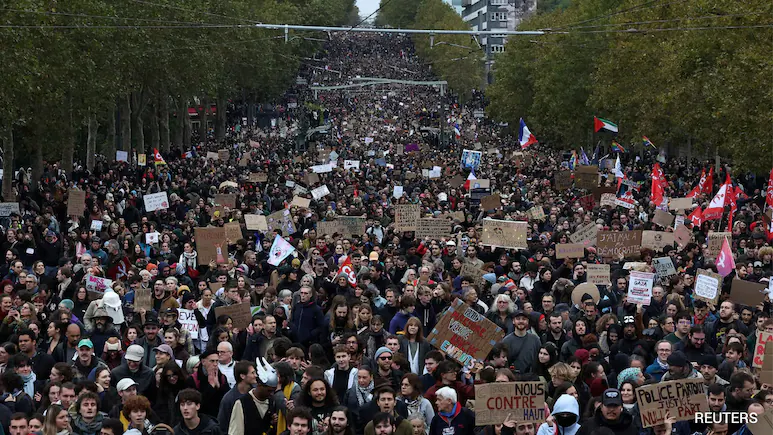
France witnessed another major day of protests on Saturday, October 24, as hundreds of thousands of people took to the streets demanding better schools, higher wages and relief from rising living costs. The demonstrations spread across the country, putting fresh pressure on President Emmanuel Macron’s government.
The march in Paris began peacefully, with students, teachers, workers and trade union members walking together in the rain. But towards the end of the demonstration, clashes broke out near Porte de Vincennes. Some protesters threw objects at police, who responded with tear gas and water cannons.
The Interior Ministry estimated that around 410,000 people demonstrated across France, including 110,000 in Paris. The CGT trade union, which helped organise the protests, put the nationwide turnout much higher, at nearly 800,000. The difference shows how widely estimates of the crowd size can vary.
So, what has brought so many people onto the streets, and why has the situation become a major challenge for Macron?
How did the protests begin?
The movement began with a local complaint about staff shortages at a high school southeast of Paris. Students and families were concerned that schools did not have enough teachers to provide the education young people needed.
But the issue soon grew beyond one school. Students began demanding more teachers, better school facilities and more places in universities. Workers and trade unions joined in, bringing their own concerns about wages, pensions and the rising cost of everyday life.
In other words, a protest that started over problems in education has become a wider expression of public frustration.
Many demonstrators believe that public services are struggling while ordinary people find it increasingly difficult to manage their expenses.
What are students demanding?
Students say that improving education requires more than promises. They want practical changes that can be seen in classrooms and universities.
Their demands include:
-More teachers and fewer lessons lost because absent teachers are not replaced.
-Repairs to schools and university buildings.
-More places in higher education.
-Changes to Parcoursup, France’s national university admissions system.
-An increase of €200 a month in student grants.
-A freeze on rents in public student housing.
The concerns are not limited to what happens inside classrooms. Students also say that the cost of accommodation and daily expenses makes it difficult for many young people to continue their education.
Education Ministry figures cited in reports show that French public middle and high schools lost 15.4 million teaching hours during the 2024–25 school year because absent teachers were not replaced. That was equivalent to 7.5% of scheduled teaching time.
For students, the concern is straightforward: if lessons are repeatedly missed and schools lack the staff or facilities they need, the quality of education suffers.
Why are rising living costs adding to the anger?
The protests are also about money.
When energy bills, rent, food and other basic expenses rise, households have less money left for everything else. Students may struggle to pay for accommodation, while workers can find that their wages are not keeping pace with their expenses.
According to figures from France’s national statistics agency, INSEE, energy prices were 21.3% higher in September than a year earlier, while overall inflation reached 3.1%.
These pressures help explain why the demonstrations have attracted people who are not directly involved in the education system.
For some, the protest is about better schools. For others, it is about wages, pensions or simply being able to afford a reasonable standard of living.
Camille Chesnier, a 27-year-old engineering graduate, told reporters she had struggled to find work despite holding an engineering degree and a master’s degree. Her experience reflects a wider concern among young people who feel that qualifications do not always lead to secure employment.
Why did clashes break out in Paris?
The Paris march was largely peaceful at first. Trade union members led the procession, followed by students and other demonstrators carrying flags and handmade placards.
However, violence broke out near the march’s endpoint at Porte de Vincennes. Some protesters threw projectiles at police, who used tear gas and water cannons to disperse the crowd.
Police also used tear gas in cities including Lyon, Clermont-Ferrand and Strasbourg. Water cannons were reported in Nice and Nantes, while clashes also occurred in Marseille.
Authorities had deployed up to 70,000 officers nationwide, supported by helicopters, armoured vehicles and water cannons. The large deployment followed widespread rioting and looting during the previous weekend’s demonstrations.
The Paris prosecutor’s office initially reported that 64 people had been arrested in connection with Saturday’s Paris demonstration, with 40 placed in police custody. Those arrested included six minors. The reported suspected offences mainly involved weapons or participation in groups allegedly preparing violence or property damage.
It is important to distinguish between the wider protest movement and those involved in violence. The fact that clashes occurred does not mean that everyone who joined the demonstrations was involved in them.
Why are protesters angry with the government’s response?
The government says it needs to protect people, businesses and public buildings after the previous weekend’s destruction. Authorities restricted the Paris march to the city’s southeastern edge, away from central areas that had been damaged during earlier unrest.
But some protesters and trade union leaders see these restrictions differently. They argue that moving marches away from city centres and banning demonstrations in certain cities limits their ability to make their voices heard.
Soumaya Abed, a 58-year-old nurse who has taken part in demonstrations for more than three decades, said the events of the previous weekend were being used as a reason to silence protesters.
This disagreement has become another part of the crisis. The government says public safety must come first, while demonstrators argue that the right to protest must also be protected.
The challenge for the authorities is to prevent violence without treating peaceful demonstrators as if they were responsible for every act of vandalism or looting.
What has Macron done so far?
Macron met representatives of high school students on Friday, October 23. According to the students, he promised changes to the university admissions system. However, they said they wanted concrete measures to be announced and urged people to continue protesting until that happened.
The crisis comes as Macron approaches the end of his presidency, with France due to elect his successor in 2027. His government is facing criticism from different sides of the political spectrum.
The far-right National Rally, led by Marine Le Pen, has accused the government of failing to protect the public. On the other side, left-wing politicians and activists have criticised the handling of demonstrations and the restrictions placed on protesters.
This means the unrest is not just about education and living costs. It is also becoming a political test for a president whose popularity has fallen since he took office in 2017.
What do the protests mean for France’s future?
The demonstrations highlight a growing gap between what many people expect from public services and what they feel they are receiving.
Students want better schools and fairer access to universities. Workers want wages and pensions that allow them to live with greater financial security. Families are worried about everyday costs, while shopkeepers are concerned about damage to their businesses during periods of unrest.
There is also a wider political question: how can the government respond to public anger while maintaining order and protecting the right to peaceful protest?
The consequences are already being felt beyond the streets. Several major Paris museums, including the Louvre and the Musée d’Orsay, were closed on Saturday as a precaution. Organisers of Art Basel Paris also cancelled the fair’s weekend programme because of security concerns.
Meanwhile, organisers associated with the Yellow Vest movement have called for another round of rallies on October 31.
The bottom line
France’s latest protests began with concerns about teacher shortages but have grown into a broader movement over education, living costs, jobs and public services.
The clashes in Paris have added pressure on Emmanuel Macron’s government, but the movement cannot be understood through images of violence alone. Thousands of people have also taken part in peaceful marches to demand changes they believe are necessary for their future.
The government must now deal with two challenges at the same time: protecting public safety and responding to the social and economic concerns that have brought so many people onto the streets.
Whether the protests lose momentum or grow further will depend in part on whether demonstrators see real changes in schools, universities and household costs—not just promises.
Report a mistake
Related stories
20-Year-Old Co-Pilot’s Mayday Calls Before Fatal Florida Plane Crash Revealed
Israel Election Deadlock: Netanyahu Leads as Opposition Closes Gap

UAE Honours flydubai Crew for Courage During September In-Flight Incident
Reader comments (0)
No comments yet. Be the first.