France Curfews After Violent Protests: Macron Rejects Interior Minister’s Resignation
France is tightening security after protests over living costs and poor public services turned violent. More than 2,400 people were arrested, while the government faces questions over police preparedness and public safety.

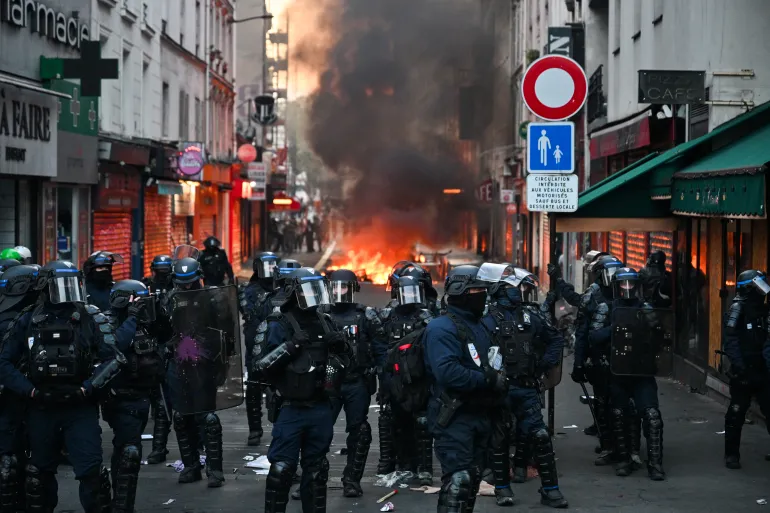
France is facing a serious law-and-order challenge after a weekend of protests turned into violence, looting and fires in several cities. What began as public anger over rising living costs and poor conditions in schools escalated into clashes with police and attacks on shops and public buildings.
The government is now trying to prevent the violence from spreading further. Prime Minister Sébastien Lecornu has asked regional authorities to introduce limited curfews in areas where there is a risk of further unrest. Meanwhile, President Emmanuel Macron has rejected the resignation of Interior Minister Laurent Nuñez and ordered a review of what went wrong in the security arrangements.
Authorities reported that more than 2,400 people were arrested over the weekend. Businesses were looted or damaged, and public buildings were attacked in several locations. The violence has also triggered a debate over whether the authorities did enough to prepare for the protests.
Why are protests taking place in France?
The demonstrations have been driven by public frustration over the cost of living and concerns about public services, particularly conditions in schools.
For many people, the issue is about the growing pressure of everyday expenses and the feeling that essential services are not meeting public needs. Student protests over overcrowded classrooms, teacher shortages and inadequate resources have also contributed to the wider unrest.
However, it is important to make one distinction: not everyone who joined the demonstrations was involved in violence. Peaceful protesters raised concerns about living costs and education, while separate groups were accused of looting shops, setting fires and attacking public buildings.
The government has condemned the violence and says those responsible must face legal action. At the same time, the protests have raised questions about how authorities should respond to public anger without restricting the right to peaceful assembly.
What are the proposed curfews, and why are they being considered?
Prime Minister Lecornu has instructed local authorities, known as prefects, to introduce “very limited” and “localised” curfews where necessary to prevent further rioting and looting.
A curfew generally means restricting people from being outside in a particular area during specified hours. In this case, the government is proposing targeted restrictions rather than announcing a nationwide curfew.
The idea is to give police a way to prevent fresh violence in areas considered particularly vulnerable. The exact locations and timings depend on decisions by the relevant authorities.
Lecornu defended police officers who had faced violent groups during the protests. He also said the government would consider declaring a state of emergency if the situation made it necessary. For now, however, the immediate response centres on local restrictions, stronger policing and investigations into those involved.
The government has also said that support measures for businesses affected by the unrest would become available from Tuesday.
Why did Macron reject the interior minister’s resignation?
Interior Minister Laurent Nuñez offered to resign after the violence exposed serious problems in the authorities’ response. President Macron refused to accept his resignation, saying the country needed continuity in the leadership of its security forces during the crisis.
In other words, Macron has decided that replacing the minister right now could make it harder to manage the situation. He has instead asked Nuñez to remain in office and take steps to address the failures.
Macron has also called for greater transparency about problems in security planning and intelligence-gathering. He wants the authorities to explain why they were unable to prevent the violence from escalating in some cities.
The decision does not mean the government has dismissed the criticism. Rather, the president is keeping the minister in place while demanding changes to how security operations are planned and carried out.
The minister admits police lost control in some cities
Nuñez has acknowledged that the authorities were not fully prepared for the scale and movement of the violent groups.
He said there had been a lack of anticipation in deploying security forces and that police tactics needed to adapt to groups that moved quickly from one location to another.
He also admitted that police had lost control in some major cities, pointing to the large number of businesses that were looted.
This admission has added to pressure on the government. Shopkeepers and local leaders want to know why businesses and public buildings were left vulnerable, while opposition politicians have criticised the authorities’ handling of the unrest.
Who is the government trying to identify?
Macron has called for new policing tactics to be introduced as quickly as possible. The government says it will review what happened and use the findings to improve preparations for future demonstrations.
Who is the government trying to identify?
Authorities are working to identify people suspected of taking part in the looting, arson and attacks on public buildings. Investigators are expected to examine CCTV footage, shop security recordings and material shared on social media.
The purpose is to establish who was involved in individual incidents and gather evidence that can be used in legal proceedings.
The government has blamed violent groups and troublemakers for exploiting the demonstrations. However, allegations about the involvement of particular political groups must be assessed through evidence rather than treated as proven facts.
The investigation will also be important for understanding whether security failures allowed violence to spread and what changes are needed to prevent similar incidents.
What happens next?
France is expected to increase security measures in areas at risk of further unrest. Local curfews may be introduced where authorities consider them necessary, and police will continue investigating the weekend’s incidents.
The government also faces a broader challenge: restoring public confidence while addressing the concerns that brought people onto the streets in the first place.
Stronger policing may help prevent further looting and attacks, but it will not by itself resolve public frustration over living costs and the quality of public services. How the government responds to both the violence and the underlying grievances will shape what happens next.
For now, France is trying to regain control of the situation while facing difficult questions about public safety, police preparedness and the right to peaceful protest.
Report a mistake
Related stories
20-Year-Old Co-Pilot’s Mayday Calls Before Fatal Florida Plane Crash Revealed
Israel Election Deadlock: Netanyahu Leads as Opposition Closes Gap

UAE Honours flydubai Crew for Courage During September In-Flight Incident
Reader comments (0)
No comments yet. Be the first.