Who Is a Journalist? Supreme Court Flags Need for Different Levels of Protection Amid Delhi Protest Row
The Supreme Court is examining allegations of police harassment of journalists during Delhi protests. It says different categories of media workers may need different safeguards, while granting interim protection to a woman journalist.

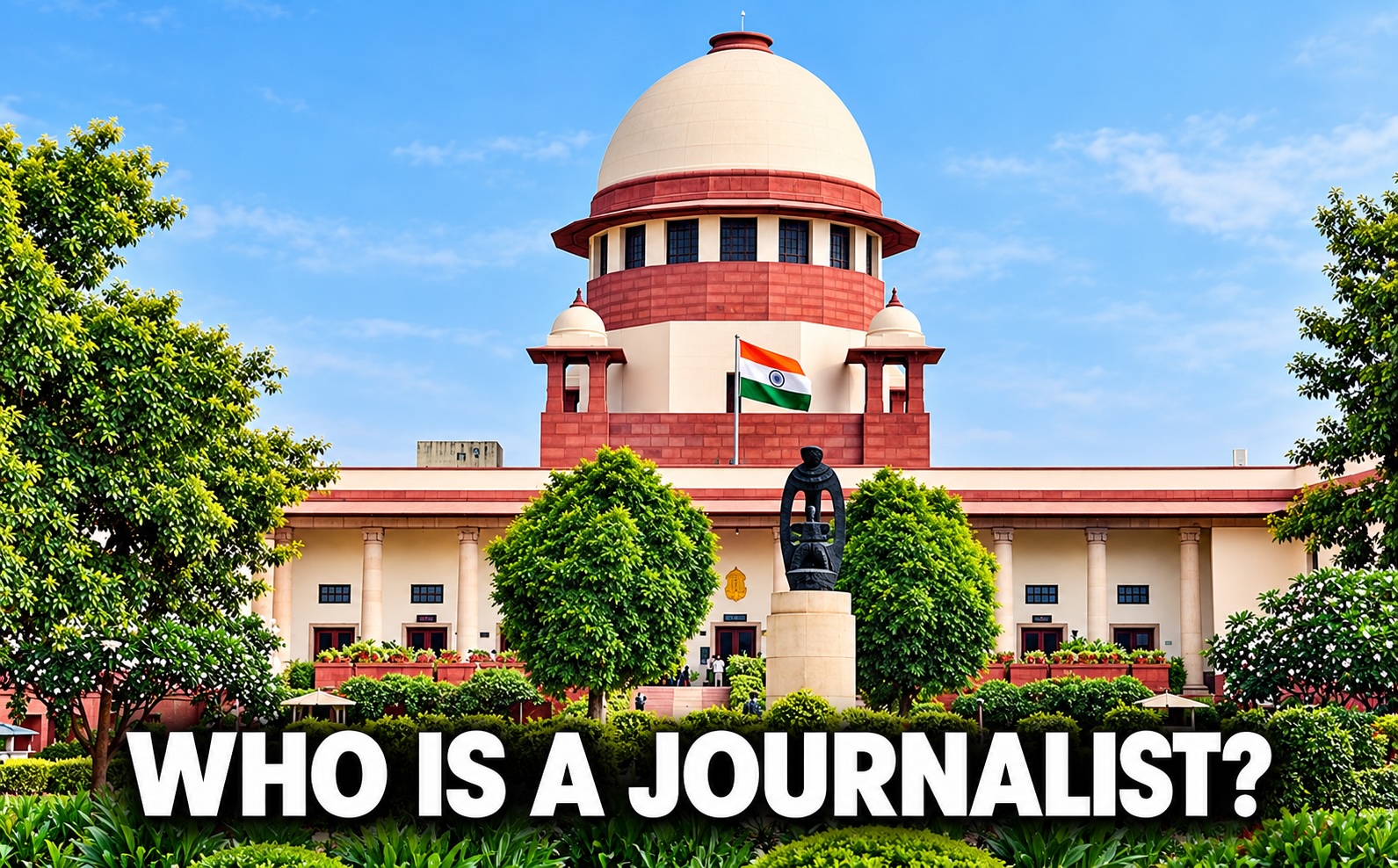
The Supreme Court of India has raised an important question about journalism in the digital age: should every person who records and uploads videos be treated in the same way as a professional journalist, and should different categories of media workers receive different levels of protection?
During a hearing related to the recent Delhi protests, a bench comprising Chief Justice of India (CJI) Surya Kant and Justice Joymalya Bagchi observed that there may be different categories of journalists, some of whom could require additional protection while performing their duties.
Justice Bagchi clarified that the Court was not deciding who qualifies as a journalist at this stage. He said the issue would require detailed examination, including questions about accredited journalists, people employed by media organisations, freelance reporters and social media influencers.
CJI Surya Kant also cautioned that if everyone began claiming to be a journalist, it could create difficulties.
The observations came as the Court heard petitions alleging that journalists covering protests in Delhi had been manhandled, detained and obstructed by police. Some petitions also raised serious allegations of sexual harassment and inappropriate treatment of women journalists.
Importantly, the Court has not yet delivered a final ruling defining who is a journalist or establishing a complete set of national rules for police dealing with journalists.
Why has this issue reached the Supreme Court?
The case is connected to protests held in Delhi over demands for the resignation of Chief Election Commissioner Gyanesh Kumar and objections to the Special Intensive Revision (SIR) of electoral rolls.
Journalists were present at the protests to report developments, record events and speak to participants. Petitions filed before the Supreme Court alleged that some reporters were pushed, manhandled or detained despite identifying themselves as members of the media. Lawyers also alleged that the authorities seized journalists' electronic devices.
The petitions have raised a broader concern: when police control a protest or disperse a crowd, how can they maintain public order without unnecessarily obstructing journalists who are reporting what is happening?
The question matters because news reports and video recordings from protest sites can help the public understand the events and can also become relevant evidence if allegations of misconduct are investigated.
The allegations against police personnel remain subject to investigation and judicial examination. They should not be treated as proven facts unless established through the appropriate process.
What does it mean to have different levels of protection?
Justice Bagchi referred to several possible categories, including accredited journalists, reporters employed by media organisations, freelance journalists and influencers.
These categories can differ in their working arrangements and the documents available to establish their professional role.
Accredited journalists: These are reporters formally recognised under an accreditation system operated by an authorised government or other relevant body. Accreditation can help identify them as media professionals, but it does not automatically determine every legal right they have.
Journalists employed by media organisations: These reporters work for newspapers, television channels, digital news outlets or other media organisations. They may have an employer-issued press identity card, an assignment letter or other documents confirming their work.
Freelance journalists: These are reporters who work independently or provide stories, photographs and videos to different publications. They may not have a permanent employer or government accreditation, but they can still carry out genuine journalistic work.
Influencers and independent content creators: These individuals often publish videos, commentary or other material directly on social media. Some may also undertake reporting and public-interest investigations, while others primarily create entertainment or opinion-based content.
These categories can overlap. A person may be a freelance reporter and a social media creator at the same time. Therefore, a person's job title or lack of formal accreditation alone may not always tell the complete story of what they are doing.
The Supreme Court's observations suggest that these distinctions may need to be considered when framing safeguards. The Court has not, however, ruled that only accredited or salaried journalists deserve protection.
Why does the government say identifying journalists has become difficult?
Solicitor General Tushar Mehta, representing the government, opposed a request for blanket protection for all women journalists in connection with the protests.
He argued that digital technology has made it difficult to distinguish professional reporters from people who record videos and upload them to social media. He referred to people who use microphones and cameras at protest sites and described some of this activity as “reel-making”.
His argument was that authorities may struggle to identify who is working as an independent journalist and who is simply creating social media content.
Mehta also said that no woman should be treated inappropriately, including by women police personnel.
The government's concern reflects a genuine practical question for crowd-control operations: police may need to identify people in a restricted or sensitive area while managing a large gathering. However, this concern must be balanced against the rights of journalists and other citizens.
A person recording an event is not automatically a professional journalist. But a person does not necessarily lose the ability to carry out legitimate reporting simply because they use a mobile phone, publish independently or lack a press card.
The central issue is how to distinguish genuine reporting from other activity fairly, without allowing identification rules to become a reason for arbitrary detention or harassment.
What happened to the woman journalist who alleged sexual harassment?
One of the petitions before the Court concerns a woman journalist who alleged that a Delhi Police officer sexually harassed or molested her while she was covering the protests.
Her lawyers, including senior advocate Indira Jaising, alleged that no FIR had been registered on her complaint, while a counter-case under the Scheduled Castes and Scheduled Tribes (Prevention of Atrocities) Act had been registered against her.
The police officer involved, Assistant Commissioner of Police Vivek Bhagat, has accused the journalist of making casteist remarks and publicly humiliating him during the protest. The competing allegations require investigation and should not be treated as conclusively established.
The petitioners argued that the local police should not investigate the allegations against their own personnel because of concerns about independence and impartiality. They asked the Supreme Court to consider an independent committee, preferably consisting mainly or entirely of women.
The Court described the allegations as serious and asked the authorities to complete their inquiry promptly. The Solicitor General said an affidavit would be filed within one week.
The Court also indicated that a committee could include a former woman judge, a former woman IPS officer and a woman social worker or social activist with a credible track record.
Supreme Court grants interim protection to the journalist
The Court directed that no coercive action be taken against the woman journalist in the case registered against her while the matter is being considered.
In simple terms, interim protection from coercive action means that authorities cannot take the kinds of coercive steps covered by the Court's order against her for now. It is temporary relief while the legal proceedings continue.
It does not mean that the Court has finally declared her allegations against the police officer proven, nor does it amount to a final decision on the counter-case.
The distinction is important: the Court can protect a person from certain immediate legal action while the facts and legal questions are still being examined.
Why is an independent investigation important?
When allegations involve possible misconduct by police personnel, the independence of the investigation can become an important issue.
The petitioners argue that an outside committee would be better placed to examine complaints involving police conduct, particularly allegations of sexual harassment. They want the process to be credible and to allow complainants to report incidents without fear.
An independent inquiry can help establish what happened by examining statements, available video footage, witness accounts, medical records where relevant and other evidence.
At the same time, the person accused of misconduct is entitled to a fair process. The purpose of an investigation is to establish facts, not to presume guilt in advance.
The Court's consideration of a committee does not itself mean that a final committee has already been appointed or that its findings are known.
What does the Constitution say about journalists and freedom of the press?
The Indian Constitution does not create a separate fundamental right exclusively for journalists. Instead, freedom of the press is understood as part of the freedom of speech and expression guaranteed under Article 19(1)(a).
This freedom supports the work of journalists who gather information, report public events and question those in power. It is also important for citizens who want to understand decisions affecting their lives.
However, the right is not unlimited. Article 19(2) allows reasonable restrictions on freedom of speech and expression on specified grounds, including public order and national security.
Police may take lawful steps to control crowds, prevent violence and protect public safety. But restrictions must have a lawful basis, and the presence of a camera or a press card should not be used as an excuse for unnecessary force or arbitrary treatment.
The legal challenge is to protect both public order and legitimate reporting.
Does a journalist need government accreditation to receive protection?
The Supreme Court has not yet given a final answer to this question in the present case.
Accreditation can make it easier for authorities to verify a reporter's identity, and an employer's press card or assignment letter may also help. Freelancers may establish their work through other records, such as commissions, published reports or professional documentation.
But accreditation and the underlying right to freedom of expression are not the same thing. A person may not be accredited and may still be engaged in legitimate reporting.
Any future guidelines would need to clarify how police should verify journalists at crowded or restricted locations, what documents may be considered and what safeguards should apply when identity is disputed.
The challenge is to prevent people from falsely claiming professional status without creating a system that unfairly excludes genuine freelance or independent journalists.
What could the Supreme Court's decision mean for media workers?
The Court is considering broader safeguards for journalists covering protests and other public events. It has sought responses from the Centre and Delhi Police on the demand for national guidelines governing police-media interactions.
If the Court eventually lays down clear rules, they could help answer practical questions such as:
How should police identify journalists during protests?
What should officers do when a reporter's identity is disputed?
Under what circumstances can a journalist be detained or removed from a location?
How should complaints of assault, harassment or sexual misconduct be investigated?
How should footage, phones and other reporting equipment be handled when they are seized or required for an investigation?
These are possible issues that the guidelines could address; they should not be mistaken for directions already issued by the Court.
Clear procedures could help both journalists and police. Reporters would have a better understanding of their safeguards, while officers would have clearer standards for identifying media personnel and responding to difficult situations.
The bigger picture: Press freedom, public order and accountability
The Delhi protest case raises a question that goes beyond one demonstration or one journalist: how should a democracy protect the public's right to receive information while allowing the police to maintain order?
Smartphones and social media have changed how news is gathered. A freelance reporter may publish important evidence without working for a large news organisation, while a person making a viral video may not be engaged in journalism at all. The distinction can be complicated, especially during a tense protest.
The solution must protect legitimate reporting without giving anyone an automatic exemption from lawful restrictions simply because they claim to be a journalist.
The Supreme Court's remarks indicate that it recognises the complexity of the issue. Its eventual decision may help clarify the safeguards that should apply to different types of media workers.
For now, the key developments are the Court's consideration of stronger protections, its request for a prompt inquiry into serious allegations involving a woman journalist, and its direction that no coercive action be taken against her in the case covered by its order.
The final legal position remains open. The Court has not yet issued a comprehensive definition of a journalist or concluded the investigation into the allegations. The outcome will matter for journalists, police officers and citizens who depend on independent reporting to understand events in the country.
Report a mistake
Related stories
Gujarat ATS Takes Salim Ismail Dola into Custody in ₹438-Crore Vadodara Drug Case
BMC Should Repost Dia Mirza’s Pollution-Free Diwali Video: Deputy Mayor Sanjay Ghadi
Gujarat CM Bhupendra Patel Inaugurates ₹48.22-Crore Modern Hospital in Vapi
Reader comments (0)
No comments yet. Be the first.