Kolkata Durga Puja Stampede: 19 Dead, 25 Injured; Crowd Management Under Investigation
At least 19 people died and 25 were injured in a stampede at Kolkata’s Chorbagan Durga Puja pandal amid heavy rain and a sudden crowd surge. Police are investigating possible safety and crowd-management failures.

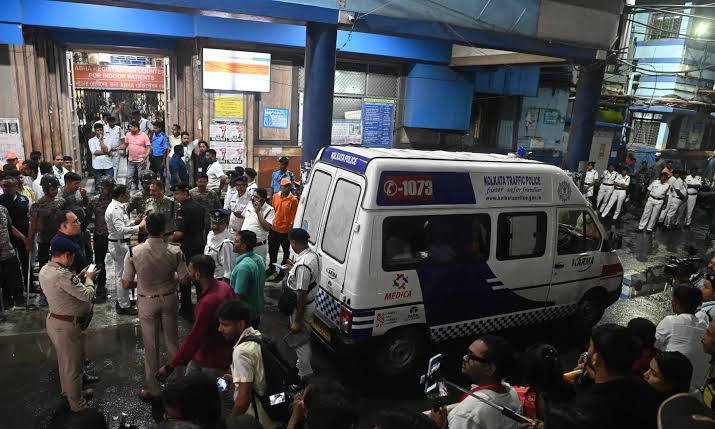
At least 19 people died and 25 others were injured after a stampede at the Chorbagan Sarbojanin Durga Puja pandal in north Kolkata on Saturday evening, October 17, 2026. The tragedy occurred during Maha Saptami, one of the major days of Durga Puja celebrations, when large numbers of people visit decorated pandals to offer prayers and see the festive displays.
The incident took place at around 7:15–7:40 pm, according to different reports. Heavy rain, a sudden movement of people towards the pandal and confusion over crowd movement are among the factors being examined.
The pandal is located near the narrow Radha Madhab Saha Lane. According to eyewitness accounts, people waiting outside rushed forward when the rain began, while the area inside was already crowded. The resulting pressure reportedly left visitors struggling to move. Some people fell near a flight of stairs by the exit, and others fell on top of them.
The exact sequence of events and the responsibility for the tragedy remain under investigation. Police are examining CCTV footage, questioning organisers and security personnel, and collecting evidence from the site.
How did the crowd surge become deadly?
A stampede is commonly described as a situation in which people rush in panic. However, many deadly incidents at crowded public events are better understood as crowd crushes: people are packed so tightly that they cannot control their movement or breathe properly.
When a large crowd moves towards a narrow entrance or exit at the same time, people at the front may be unable to move forward. Those behind them may not realise that movement has stopped and continue pushing. The pressure can spread through the crowd, causing people to lose their balance or become trapped against barriers, walls or other people.
A person who falls in such a situation may be unable to get back up because others have little room to move around them. If several people fall, the danger can increase rapidly.
In Kolkata, reports suggest that heavy rain prompted visitors outside the pandal to move towards shelter while others were already inside. The narrow approach, the movement of people near the exit and the reported fall of visitors on stairs are important points for investigators to examine.
The tragedy shows why crowd safety depends not only on preventing panic but also on controlling the number of people entering, keeping exits clear and ensuring that the crowd can move in a planned direction.
Did rain, announcements and security arrangements contribute?
Investigators are examining several possible factors.
1. Heavy rainfall
Rain can cause visitors to seek shelter quickly. If a large number of people move towards the same covered area, the crowd can become dangerously dense within minutes.
Reports from the scene indicate that rainfall was an important factor in the sudden movement of visitors. However, the investigation must establish precisely how the weather affected the crowd and whether organisers had a plan to manage such a situation.
2. Confusion over announcements
West Bengal Chief Minister Suvendu Adhikari reportedly said that an announcement by the organisers may have triggered the rush. Eyewitnesses also raised questions about announcements concerning entry, exit and crowd movement.
Police are expected to examine what was announced, when it was announced, and whether the instructions were clear to visitors. A confusing or misleading announcement can cause people to move in different directions or rush towards a particular entrance.
At this stage, the role of any specific announcement should be treated as a matter under investigation, not as a conclusively established cause.
3. Narrow entry and exit routes
A narrow lane and restricted movement around an event venue can create a bottleneck. If people entering the venue cross paths with those trying to leave, the two streams of movement can obstruct each other.
Reports have also raised questions about the stairs near the exit and the design of the visitor route. Investigators will need to establish whether the available routes were suitable for the number of visitors present and whether exits remained usable during the emergency.
4. Police and private security deployment
Local residents questioned whether enough police personnel and volunteers were available to manage the crowd, alleging that security deployment was concentrated near the VIP entrance.
These claims require verification. Investigators will need to examine deployment records, the number of guards and volunteers on duty, the crowd-control plan and how personnel responded once the situation became dangerous.
What are police investigating now?
Kolkata Police are examining whether inadequate crowd management, unclear instructions, the layout of the venue or other safety failures contributed to the incident.
A forensic team visited the site to collect evidence. Police are also examining CCTV footage and questioning people involved in organising and securing the event.
The investigation is expected to look at the responsibilities of the puja committee, private security personnel and officers deployed at the venue. Authorities will need to establish whether the organisers followed applicable safety requirements and whether the crowd-control arrangements were adequate for the number of visitors.
The distinction matters: a tragic outcome does not automatically prove that a particular person or organisation was negligent. Evidence must establish what precautions were required, what actually happened and whether any failure contributed to the deaths or injuries.
Why are crowd-management plans so important at Durga Puja pandals?
Durga Puja is among the biggest public celebrations in West Bengal. In Kolkata, popular pandals can attract large crowds over several days, with visitors arriving from different parts of the city and beyond.
Temporary pandals, narrow roads, barricades, decorative structures and changing weather can make crowd management especially challenging. A plan that works when visitor numbers are low may not be sufficient during peak evening hours.
Good crowd management usually requires several safeguards:
Controlled entry: The number of people allowed inside should be managed according to the venue's safe capacity.
Separate movement routes: Entry and exit routes should be clearly marked and, where possible, separated to prevent people from moving against each other.
Clear announcements: Instructions should be short, consistent and understandable to visitors, with trained personnel guiding the crowd.
Adequate staffing: Police, trained volunteers, security guards and emergency teams should know their positions and responsibilities.
Emergency access: Ambulances and rescue teams must be able to reach the affected area quickly.
Weather contingency plans: Organisers should plan for sudden rain and know when to pause entry or temporarily stop the movement of visitors.
These are general crowd-safety principles. The investigation must determine which requirements applied to the Chorbagan venue and whether they were followed.
Why can a crowd crush cause deaths even without a major fall?
Many people assume that stampedes are deadly mainly because people are trampled underfoot. That can happen, but it is not the only danger.
When a crowd becomes extremely dense, the pressure from surrounding bodies can restrict chest movement. A person may be unable to take a full breath, even while standing. This can lead to compression-related asphyxia, a condition in which the body does not receive enough oxygen.
People may also suffer injuries when they fall against stairs, barriers or other people. In a tightly packed crowd, bystanders may be physically unable to help someone who has fallen.
This is why crowd safety experts emphasise preventing dangerous density before it develops. Once a crowd becomes compressed, it may be too late for people to move away independently.
What should visitors do if a crowd becomes dangerously packed?
Public-event safety experts generally advise people to remain alert to crowd pressure and avoid pushing forward when movement has stopped.
If a crowd becomes tightly packed:
Avoid pushing against the people in front of you.
Keep your arms in front of your chest where possible to preserve some breathing space.
Try to remain upright and move with the crowd rather than fighting against its direction.
Avoid bending down to pick up dropped belongings in a moving crowd.
Follow clear instructions from trained emergency personnel and move towards a safe, open area when it is possible to do so.
These precautions cannot guarantee safety in an extreme crowd crush. The primary responsibility is to prevent dangerous overcrowding through proper planning and timely intervention.
A reminder of earlier crowd-safety concerns
Kolkata has experienced serious crowd-management challenges at popular Durga Puja venues in the past. In 2015, the enormous crowds drawn to the Deshapriya Park pandal caused widespread congestion and disruption. That incident did not result in deaths, but it demonstrated the pressure that a highly popular attraction can place on roads and surrounding neighbourhoods.
The Chorbagan tragedy is far more serious because it has resulted in multiple deaths. It raises questions about whether crowd density, access routes, emergency exits and staffing were adequately assessed before the celebrations.
Each incident has its own circumstances, so earlier events cannot establish what caused the latest tragedy. They do, however, underline the need for event-specific risk assessments and clear emergency plans.
What happens next?
The immediate priorities are medical treatment for the injured, support for the families of those who died and a thorough investigation into the circumstances of the incident.
Police will need to establish how the crowd began moving, what role the rain and announcements played, whether routes became blocked and whether the security arrangements were adequate. The evidence will determine whether any legal or administrative action is warranted.
The tragedy also raises a wider question for public-event organisers and authorities across India: are safety arrangements designed for the largest crowds a venue may attract, rather than the average number of visitors?
The bottom line: Heavy rain and a sudden crowd surge appear to have been important factors in the Chorbagan disaster, but the exact causes and any responsibility for safety failures must be established through investigation. The deaths underline why clear communication, safe entry and exit routes, controlled crowd density and effective emergency planning are essential at major public gatherings.
Report a mistake
Related stories
Gujarat ATS Takes Salim Ismail Dola into Custody in ₹438-Crore Vadodara Drug Case

BMC Should Repost Dia Mirza’s Pollution-Free Diwali Video: Deputy Mayor Sanjay Ghadi
Gujarat CM Bhupendra Patel Inaugurates ₹48.22-Crore Modern Hospital in Vapi

Reader comments (0)
No comments yet. Be the first.