Jaishankar to Meet Marco Rubio in Mumbai on October 20; Rahul Gandhi Questions Modi Government
The MEA has confirmed S. Jaishankar’s talks with US Secretary of State Marco Rubio in Mumbai on October 20, after Rahul Gandhi criticised the government over the handling of the announcement.

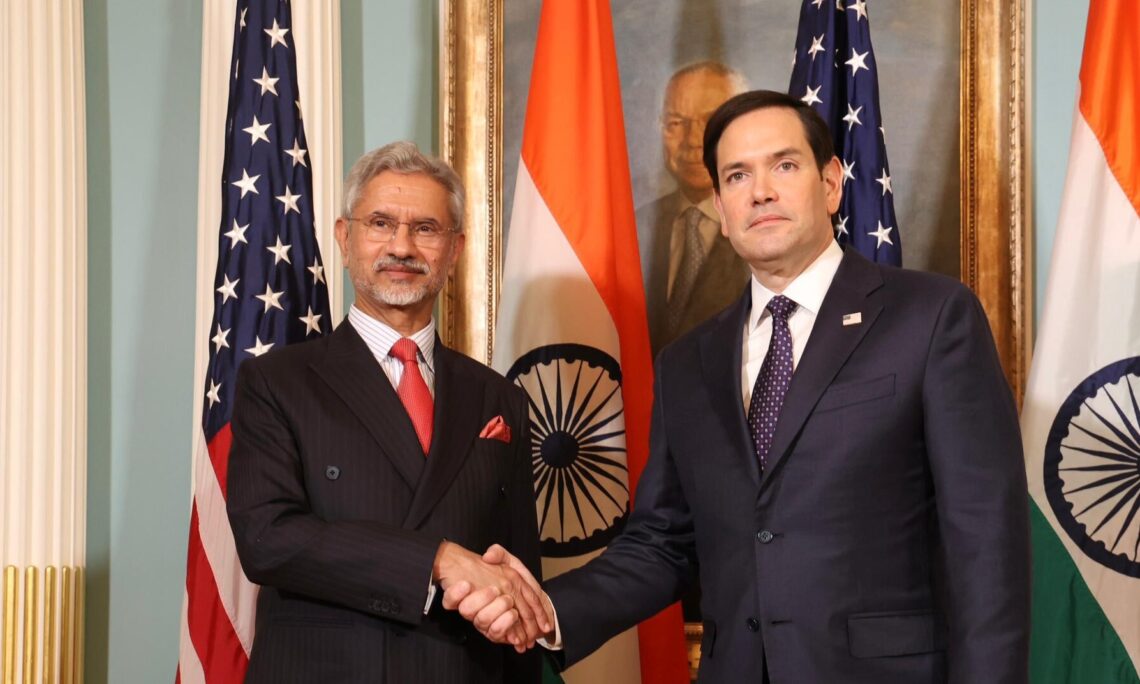
India’s Ministry of External Affairs (MEA) has confirmed that External Affairs Minister S. Jaishankar will hold talks with US Secretary of State Marco Rubio in Mumbai on October 20, 2026. The announcement came after Congress leader and Lok Sabha Leader of Opposition Rahul Gandhi questioned the government over the planned meeting and the way information about it had been communicated.
MEA spokesperson Randhir Jaiswal confirmed the schedule on Friday, October 16. He also announced that Jaishankar would host United Arab Emirates (UAE) Deputy Prime Minister and Foreign Minister Abdullah bin Zayed Al Nahyan in Mumbai on October 19 and 20.
Jaishankar is also scheduled to attend an event marking the 250th anniversary of the independence of the United States, where he will be the guest of honour, according to the MEA.
The confirmation has put the spotlight on two issues: the diplomatic agenda between India and the US, and the political controversy over why the meeting details were not publicly announced by India earlier.
Why did Rahul Gandhi criticise the government? The controversy began after US Ambassador to India Sergio Gor indicated that American officials expected Jaishankar to meet Rubio in Mumbai.
The statement prompted Congress leaders to question why the Indian government had not announced the meeting itself. Congress general secretary Jairam Ramesh described the situation as unusual and asked why details of the engagement were being communicated by a US official rather than India's foreign ministry.
Rahul Gandhi later took a swipe at Prime Minister Narendra Modi on social media platform X.
He wrote: “Mr Rubio has summoned his employee to Mumbai. Modi ji, your officials in the external affairs ministry are confused about what's going on. You might want to explain. Unless, of course, you want me to.”
Gandhi’s remark suggested that the meeting arrangements made India appear to be responding to Washington rather than acting as an equal diplomatic partner.
However, this was a political criticism, not an established finding that the US had ordered the Indian minister to attend the meeting. The publicly confirmed information is that Jaishankar and Rubio are scheduled to hold talks in Mumbai on October 20.
What did the MEA say about holding talks outside Delhi?
In response to questions about Jaishankar’s engagements in Mumbai, MEA spokesperson Randhir Jaiswal defended the practice of hosting foreign leaders and officials in Indian cities other than New Delhi.
He said India had been following this practice for around a decade. He cited examples of Prime Minister Narendra Modi hosting the Spanish Prime Minister in Vadodara, German Chancellor Friedrich Merz in Ahmedabad and the Prime Minister of Mauritius in Varanasi.
Jaiswal also referred to Jaishankar’s previous diplomatic engagements in Goa, Kevadia in Gujarat and Amritsar.
The government’s position is that diplomatic meetings do not always have to take place in the national capital. Hosting a foreign visitor in another city can also showcase India’s different regions, economic centres and cultural strengths.
In simple terms: the location of a diplomatic meeting does not, by itself, establish which country has the upper hand. To assess the relationship, it is more useful to examine the agenda, the agreements reached and the positions both governments take.
Who is Marco Rubio, and why is his visit important?
Marco Rubio is the US Secretary of State, the senior American official responsible for foreign policy and diplomatic relations. His role is broadly comparable to that of India's External Affairs Minister.
The US State Department announced that Rubio would travel to Samarkand in Uzbekistan and then to Mumbai and Jamnagar in India from October 17 to 22.
According to the US announcement, the visit aims to strengthen the India-US strategic partnership, discuss regional and global developments, and explore opportunities for greater energy cooperation. Rubio is also expected to meet business leaders to promote investment and economic cooperation.
The visit is significant because India and the United States cooperate in several areas, including defence, technology, trade, energy and regional security. At the same time, the two countries do not agree on every issue, and their discussions must address differences as well as shared interests.
What could India and the US discuss?
The official announcement highlights energy cooperation and the broader strategic relationship. Reporting on the planned talks has also identified trade, investment, defence and critical and emerging technologies as important areas of bilateral engagement.
Here is what these subjects mean for ordinary Indians.
1. Energy and fuel security
India imports a large share of the crude oil it consumes. Maintaining access to reliable and affordable energy supplies is important because changes in global oil prices can affect transport costs, inflation and household budgets.
India and the US could explore ways to expand energy trade and cooperation. However, the precise agreements, if any, will depend on the outcome of the discussions.
2. Trade and investment
Trade involves the buying and selling of goods and services between countries. Investment means businesses putting money into factories, infrastructure, technology or other activities.
Stronger economic ties could create opportunities for Indian exporters and businesses. But trade negotiations can also involve difficult questions about tariffs, market access and the treatment of companies operating in each country.
A meeting does not automatically mean a trade agreement has been finalised.
3. Defence and security
India and the US have expanded defence cooperation over the years. Their discussions can involve military equipment, technology, training and coordination on regional security.
Such cooperation matters because both countries have interests in a stable Indo-Pacific region, although their strategic priorities are not always identical.
4. Critical and emerging technologies
This refers to strategically important technologies such as semiconductors, artificial intelligence, advanced telecommunications and other technologies that can affect economic competitiveness and national security.
Cooperation in these fields could support investment, research and industrial development. The specific projects or commitments arising from the talks, if any, will need to be confirmed by the governments.
Why is Rubio visiting Jamnagar?
Rubio’s planned India itinerary includes Jamnagar in Gujarat, an important centre for the oil-refining industry.
Jamnagar is home to Reliance Industries’ major refining complex. A visit to the city is relevant to the wider discussion about energy, commercial engagement and investment between India and the United States.
The US has publicly described energy cooperation as one of the aims of Rubio’s trip. However, the precise commercial discussions and any resulting commitments should not be assumed before they are officially announced.
Why is the UAE foreign minister also visiting Mumbai?
Jaishankar is scheduled to host UAE Deputy Prime Minister and Foreign Minister Abdullah bin Zayed Al Nahyan on October 19 and 20, overlapping with Rubio’s visit.
The UAE is an important partner for India. The relationship includes energy supplies, trade, investment, employment opportunities for Indians in the Gulf and cooperation on regional issues.
India also has a large Indian community living and working in the UAE. Decisions affecting economic ties, business activity and travel can therefore have wider importance for Indian citizens.
Hosting senior representatives from both the UAE and the US in Mumbai during the same period highlights India’s engagement with multiple important partners.
It does not, on its own, establish that the meetings are part of a single coordinated negotiation. The outcomes of each engagement will depend on the discussions held.
What does the 250th anniversary of US independence mean?
The United States marks its independence on July 4, commemorating the adoption of the Declaration of Independence in 1776. The year 2026 marks 250 years since that event.
The anniversary is commonly called the United States’ semiquincentennial, meaning a 250-year anniversary.
Jaishankar’s planned participation as guest of honour at a related celebration is part of the diplomatic programme announced by the MEA. The event also provides an opportunity to recognise the longstanding relationship between the two countries.
Does the Mumbai meeting indicate a change in India-US relations?
The meeting comes at a time when both countries have reasons to maintain dialogue on energy, trade, investment and security. But the visit should not automatically be interpreted as a breakthrough or a sign of a major diplomatic shift.
A more reliable assessment will depend on the official statements issued after the talks, whether concrete agreements are announced, and whether both sides make progress on outstanding differences.
The political dispute over the announcement is a separate issue. Congress has questioned the government's communication and diplomatic handling, while the MEA has confirmed the meeting and explained that hosting foreign dignitaries outside Delhi is an established practice.
The bigger picture
The Jaishankar-Rubio meeting is important because India and the US are major partners whose decisions can influence trade, energy security, technology and regional stability.
Rahul Gandhi’s criticism has added a domestic political dimension to the visit, raising questions about the government's communication and the public presentation of India's diplomatic engagements.
For now, the confirmed position is clear: Jaishankar is scheduled to meet Rubio in Mumbai on October 20, while the UAE foreign minister is due to visit on October 19 and 20. The real measure of the visit will be what the two sides discuss, what they agree on and whether those discussions lead to practical results.
Report a mistake
Related stories
Gujarat ATS Takes Salim Ismail Dola into Custody in ₹438-Crore Vadodara Drug Case
BMC Should Repost Dia Mirza’s Pollution-Free Diwali Video: Deputy Mayor Sanjay Ghadi
Gujarat CM Bhupendra Patel Inaugurates ₹48.22-Crore Modern Hospital in Vapi
Reader comments (0)
No comments yet. Be the first.