Actor Imran Khan Challenges ‘Leave India’ Notice in Bombay High Court After Protest
Actor Imran Khan Pal has challenged an order directing him to leave India by October 28 after attending a Mumbai protest. He calls the notice arbitrary and says he was not given a hearing.

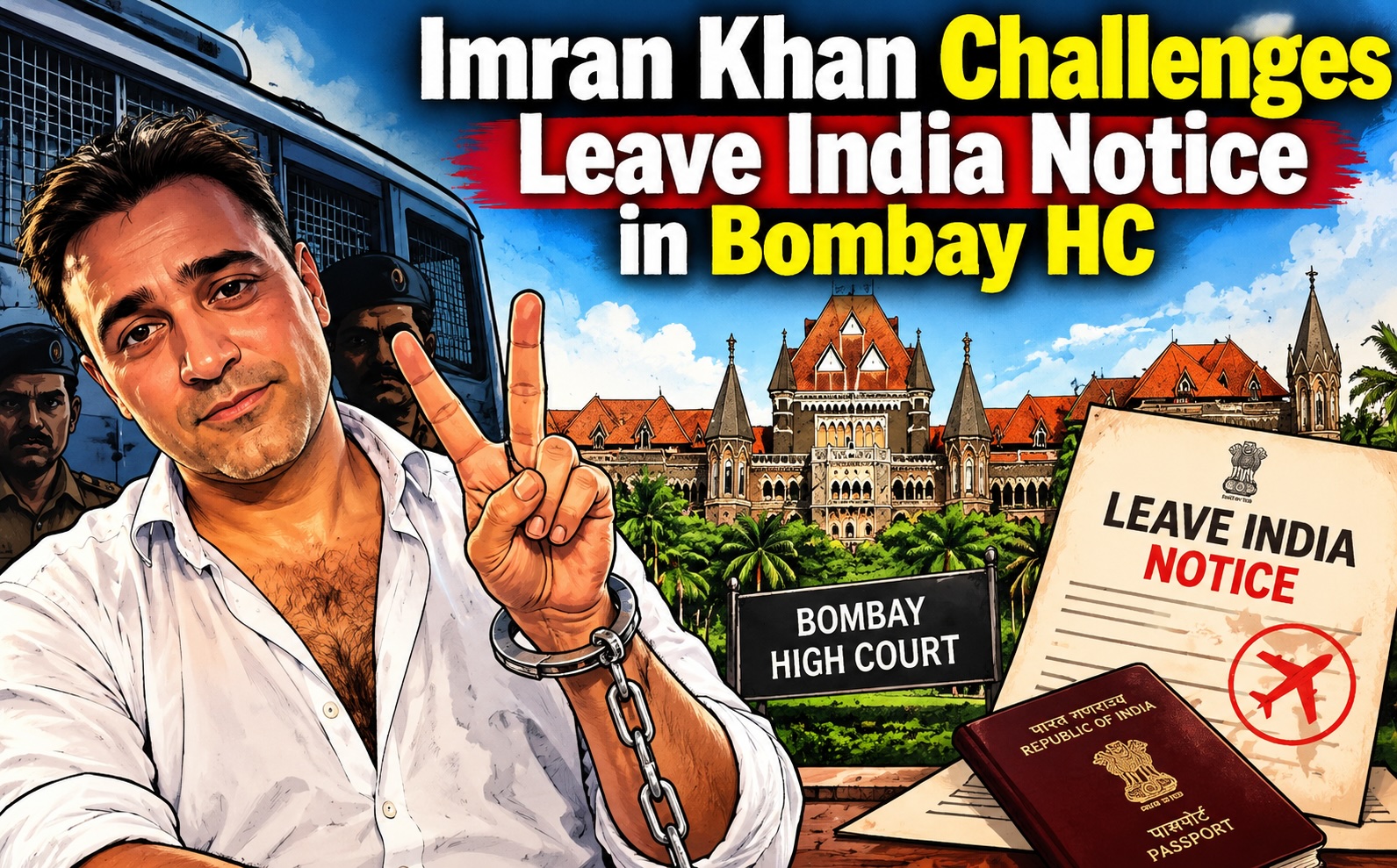
Actor Imran Khan Pal has approached the Bombay High Court to challenge a notice issued by the Foreigners Regional Registration Officer (FRRO), Mumbai, directing him to leave India by October 28, 2026.
In his petition, Khan has described the notice as arbitrary, unreasonable and legally unjustified. He argues that the authorities acted against him without first giving him a proper opportunity to explain his position.
The dispute has drawn attention because the notice followed his presence at a protest in Mumbai on October 10. The protest was linked to demands for the resignation of Chief Election Commissioner Gyanesh Kumar and opposition to the revision of electoral rolls.
Khan is seeking the cancellation of the notice and an immediate stay on its implementation while the court considers his case.
An important point: The Bombay High Court has not yet delivered a final judgment on the challenge. The actor's claims are arguments made in his petition, and the legality of the notice remains to be decided.
Who is Imran Khan Pal?
The person involved in this case is Imran Khan Pal, an actor who holds United States citizenship and has Overseas Citizen of India (OCI) registration.
He has reportedly lived in India since he was about two years old. His petition says that he has spent most of his life in the country and has family and livelihood ties here.
This case should not be confused with the better-known Bollywood actor Imran Khan, who starred in films such as Jaane Tu... Ya Jaane Na. The legal dispute concerns Imran Khan Pal.
His OCI status is central to the case because OCI registration allows eligible foreign citizens of Indian origin to live in India under a specific legal framework. However, OCI registration is not the same as Indian citizenship.
Why did the authorities issue the notice?
According to media reports, Khan was present at a protest held near August Kranti Maidan in Mumbai on October 10. Demonstrators were protesting against Chief Election Commissioner Gyanesh Kumar and raising concerns about the Special Intensive Revision (SIR) of electoral rolls.
The protest was part of a wider political dispute over voter-list revision and the functioning of the Election Commission.
Khan was reportedly detained during the protest. A complaint was subsequently made alleging that his participation violated immigration law.
On October 14, the FRRO issued a notice directing him to leave India by October 28. The notice reportedly referred to provisions of the Immigration and Foreigners Act, 2025.
Khan disputes the action. His petition says he had no association with the organisation involved in organising the protest and argues that his mere presence at the protest did not justify directing him to leave the country.
The precise legal grounds and supporting material relied upon by the authorities are among the issues in dispute.
What is a ‘Leave India Notice’?
A Leave India Notice is a direction issued by the competent authorities requiring a foreign national to leave India within a specified period.
India regulates the entry, stay and departure of foreign nationals through immigration laws. Depending on the circumstances, authorities can take action when they believe a foreign national has breached applicable legal requirements or conditions governing their stay.
Such action can have serious consequences. A person may be required to leave the country, and related immigration or registration questions may arise.
However, the existence of immigration powers does not automatically make every order lawful. The authority must act within the powers granted by law and comply with applicable legal and constitutional requirements.
In Khan's case, the court will need to consider the legal basis of the notice and the objections raised in his petition.
Why is his OCI status important?
OCI stands for Overseas Citizen of India. It is a registration category available to eligible foreign citizens of Indian origin and certain other qualifying people under Indian law.
An OCI card provides several benefits, including long-term visa-free travel to India, subject to the applicable rules. It does not make its holder an Indian citizen and does not provide all the rights available to citizens.
OCI cardholders remain foreign nationals. Their status is governed by the Citizenship Act, 1955, and the relevant rules and notifications.
The distinction matters because Khan is challenging both the direction to leave India and the way the authorities have treated his OCI status.
According to The Indian Express, the FRRO issued a separate show-cause notice on October 17 asking why his OCI registration should not be cancelled under Section 7D(e) of the Citizenship Act.
A show-cause notice is not the same as a final cancellation order. It asks the person concerned to explain why a proposed action should not be taken.
Khan has been given 15 days to respond to that notice, according to the report.
The two proceedings therefore need to be distinguished:
Leave India Notice: Directs him to leave India by October 28 and is the subject of his High Court challenge.
OCI show-cause notice: Asks him to explain why his OCI registration should not be cancelled. A final decision on cancellation would be a separate step.
What is Khan arguing in the High Court?
Khan's petition raises several legal objections.
1. He says he was not given a hearing
He argues that the authorities issued the departure notice without first giving him a reasonable opportunity to explain his position.
This raises the principle of natural justice. In simple terms, when a government decision can seriously affect someone's rights or status, the law may require the person to be informed of the case against them and given a fair opportunity to respond.
Whether a prior hearing was legally required in these circumstances, and whether the procedure followed was sufficient, will depend on the applicable law and facts.
2. He alleges that the order is arbitrary
Khan says the notice is arbitrary, unreasoned and disproportionate. He argues that the authorities have not adequately explained why his presence at the protest justified such a serious action.
An administrative order may be challenged if it is alleged to have been made without proper reasoning, for an improper purpose or without considering relevant circumstances.
These are allegations in his petition, not findings already made by the court.
3. He invokes constitutional protections
Khan relies on Articles 14 and 21 of the Constitution.
Article 14 guarantees equality before the law and equal protection of the laws. Article 21 protects life and personal liberty.
Although some constitutional rights, including certain freedoms under Article 19, are specifically guaranteed to Indian citizens, Articles 14 and 21 also protect foreign nationals in India.
Khan argues that the decision affecting his ability to remain in India must comply with these constitutional protections.
4. He disputes the connection between the protest and immigration action
His petition says he was not involved in organising the protest and had no affiliation with the organisation behind it.
He argues that his presence at a protest should not, by itself, be treated as sufficient grounds for the immigration action taken against him.
The authorities' response and the material on which they relied will be important in assessing this claim.
Can the government ask a foreign national to leave India?
Yes. Indian law gives the government powers to regulate the entry, stay and departure of foreign nationals.
Foreign citizens do not have an unconditional right to remain in India indefinitely. Their stay is subject to immigration laws and any applicable conditions.
However, the existence of government power does not mean that every exercise of that power is beyond judicial review.
Courts can examine whether an authority acted within its legal powers, followed the required procedure and complied with constitutional standards.
The central issue in Khan's case is not simply whether India can regulate the stay of foreign nationals. It is whether the particular notice issued to him was lawful in the circumstances.
The Bombay High Court will have to consider the applicable statutory provisions, the reasons for the decision and the procedural objections raised by the actor.
Does attending a protest automatically violate immigration law?
No general conclusion can be drawn that attending a protest automatically violates immigration law.
The legality of a person's conduct depends on the facts, the laws applicable to that person and the circumstances of the event.
A foreign national may be subject to immigration conditions and other laws that do not apply in exactly the same way to Indian citizens. At the same time, government action against a foreign national must still have a valid legal basis.
In this case, Khan says his presence at the protest did not justify the order directing him to leave India. The authorities' position and the evidence relevant to the notice will need to be considered through the legal process.
The court has not yet established that the notice was issued to punish him for his political views, nor has it ruled that the authorities acted lawfully.
What happens next?
Khan filed his petition on October 17, 2026, seeking urgent judicial intervention. Media reports said his lawyers were likely to mention the matter for an urgent hearing on Monday, October 19.
He is seeking to have the Leave India Notice set aside and its implementation stayed while the case is considered. He has also sought protection against coercive action, including deportation, while the legal challenge is pending.
Separately, the FRRO's show-cause notice concerning his OCI registration requires him to respond within the stipulated 15-day period.
The immediate questions are whether the High Court will grant interim protection, whether it will require the authorities to explain the basis of their decision and how the separate OCI proceedings will proceed.
As of October 18, 2026, the final outcome remains pending.
Why does this case matter beyond one actor?
The case raises broader questions about immigration powers, procedural fairness and the legal position of OCI cardholders who have lived in India for many years.
For foreign nationals, an order to leave India can affect family life, employment, property arrangements and other long-standing connections to the country.
For the government, enforcing immigration law is a legitimate responsibility. But when a person challenges an order as unlawful, the courts can examine whether the power was exercised properly.
The case also highlights the distinction between being present at a political protest and being legally responsible for a specific offence. The consequences of any alleged violation must be assessed under the relevant law and evidence.
The bottom line: Imran Khan Pal has challenged the FRRO's direction to leave India by October 28, arguing that the order was arbitrary and issued without a fair hearing. His OCI registration is also facing separate scrutiny. The Bombay High Court's consideration of the case will determine the next legal steps; no final ruling has yet settled the dispute.
Report a mistake
Related stories
Gujarat ATS Takes Salim Ismail Dola into Custody in ₹438-Crore Vadodara Drug Case

BMC Should Repost Dia Mirza’s Pollution-Free Diwali Video: Deputy Mayor Sanjay Ghadi

Gujarat CM Bhupendra Patel Inaugurates ₹48.22-Crore Modern Hospital in Vapi

Reader comments (0)
No comments yet. Be the first.